
Industry is demanding a cut in repo rate to help revive India's sagging GDP growth that hit decade's low of 4.5 per cent in the third quarter of 2012-13.

'Investors can consider staying invested in long duration products as there is a possibility of rate cuts in the near term.' Positive macros - lower inflation, high forex reserves and favourable demand-supply dynamics for government bonds - make a strong case for rate cuts from December, says Devang Shah, head of fixed income, Axis Mutual Fund. In an interview with Abhishek Kumar in Mumbai, Shah says this view may not hold true if commodity prices go up sharply.
The Reserve Bank of India (RBI) on Monday said that the timing and sequence of exit from an easy monetary policy were still a challenge.

The RBI Deputy Governor, V Leeladhar has joined the board of National Bank for Agriculture and Rural Development.
The Reserve Bank on Tuesday lowered the growth projection for the current fiscal to 5.5 per cent from its earlier estimate of 5.7 per cent and asked the government to undertake policy measures to improve investment climate.
Guidelines say that new banks need to set up 25 per cent branches in unbanked areas.

The Reserve Bank on Tuesday said the soft monetary policy adopted by it to counter the impact of the global financial meltdown on the country will continue till the economic recovery is secured.

The central board of Reserve Bank of India (RBI) has opposed a government move to have control over the central bank's staff-related matters. The proposal to make staff regulations statutory and bring them under the subordinate regulation of Parliament was discussed at RBI's board meeting in Kolkata last week.

The Reserve Bank of India has launched an assault on inflation by increasing the cash reserve ratio (CRR) 75 basis points to 5.75 per cent. While sounding upbeat on economic growth, the central bank has kept the door open for an increase in interest rates even before the annual policy statement in April.
200 staffers, consisting of RBI officials and support teams, who are essential to perform critical functions, were isolated at a separate facility in a dedicated quarantined environment near all three RBI data centres.

Amid decelerating manufacturing growth, the Reserve Bank wants the government to come out with measures in the Budget to give a boost to the sector, which can employ surplus labour from agriculture.
RBI had made available a potential liquidity of Rs 5.60 lakh crore (Rs 5.6 trillion), nearly 9 per cent of gross domestic product, to help the country tide over the liquidity crisis following the global financial meltdown triggered by the collapse of America's iconic investment banker Lehman Brothers in mid-September.

This demand comes at a time when the government is falling short of its revenue targets due to dwindling tax and low disinvestment receipts. It could account for the dividend in the upcoming Union Budget on February 1. RBI is, however, yet to take a final call on the government's demand and might decide on this at its central board meeting scheduled for February 15 in New Delhi.

RBI promises to take all necessary steps, including liquidity support

Blaming high cash balance with the Government for aggravating liquidity strain in the system, the Reserve Bank on Thursday asked it to loosen purse strings for easing the situation. "On Wednesday, the government cash balance stood at Rs 92,000 crore (Rs 920 billion).

The former bureaucrat said he will take measures which the economy requires in a timely manner and as the first step, will meet the heads of public sector banks.

The Reserve Bank of India (RBI) will meet top executives of asset reconstruction companies (ARCs) on Friday to take stock of the sector. During the meeting, ARCs will also seek clarity from the regulator on bank borrowing. While there is no regulatory ban in place, ARC sources said banks often refuse funding.

Ahead of the monetary policy review, RBI governor D Subbarao is expected to meet Prime Minister Manmohan Singh and finance minister Pranab Mukherjee on October 23.
The regulator said that it is vested within its purview to regulate the bank account for payment systems and the settlement systems are finally posted in the books of account of banks with the RBI to attain settlement finality.

Reserve Bank of India (RBI) Deputy Governor Swaminathan J criticised some non-banking financial companies (NBFCs) for lax loan appraisal practices and charging excessive interest rates, even as he acknowledged the sector's rapid expansion over the past decade, especially in recent years. "Unfortunately, some NBFCs seem to believe they can operate with weak underwriting in the pursuit of fast growth while levying excessive and unsustainable interest rates - sometimes disguised as upfront or processing fees - followed by aggressive recovery methods in case of default," Swaminathan said at the conference of NBFCs in Chennai last month.

The sharp decline in rupee against the dollar is a cause of concern and there are expectations that steps would be announced to boost the domestic currency, the finance minister said.

'In the case of corporate credit, especially to AAA borrowers, lenders will have to take a fresh look at pricing.'
A repo rate hike may hurt growth far more than it will help deal with an inflation rate that is already dropping.

The Reserve Bank of India (RBI) on Friday said it expects the economy to record positive growth in the second half of the current financial year.

The additional cash will now give the Centre more headroom for stimulating the economy.

With Deputy Governor Viral Acharya and another member Chetan Ghate voting for a status quo, RBI governor Shaktikanta Das and three others outvoted them for reduction in repo rate to 6.25 per cent from the existing 6.50 per cent.
North Block and Mint Road seem likely to now stick to the earlier convention of the RBI governor coming to Delhi and being the only MPC member meeting the finance minister and senior bureaucrats on pre-policy meetings
The Jalan panel has recommended to the RBI to keep shady entities out of banking licence race.
Govt likely to get full control on policy rate.

The rupee tumbled 3 per cent against the US dollar in 2024 as concerns over slower economic growth and a stronger greenback in global markets weighed, but it was among the least volatile currencies in the world and the headwinds may be less intense in the coming year.
The Reserve Bank of India may go in for further tightening of money supply as there is no likelihood of inflation coming to single digit in the next six months, according to indications given by the central bank governor to a parliamentary panel.
A few market and economic indicators have begun looking up, thanks to what many term the 'Rajan effect'.
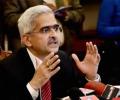
He said the impact of the second wave of COVID-19 has waned by August,and economic growth will be better from the second quarter onward on a sequential basis. Speaking at an event organised by The Indian Express and Financial Times, Das said the RBI has decided to give more emphasis on growth because of the pandemic and operate in the 2-6 per cent inflation band set by the government for it. The central bank will seek to gradually move towards achieving the 4 per cent target over a period of time, he said, adding that the possibility of a sustained increase in inflation is unlikely.

They alleged that the central bank has "failed miserably" in handling the situation post-demonetisation.

The RBI is understood to be dithering since it would want more clarity on the cost of the fiscal policies the new government would undertake before it decides to cut rates, even though it has pencilled in a lower gross domestic product growth rate for this fiscal year.

RBI staff tell Governor Urjit Patel that the central bank's image of efficiency and independence has 'gone into smithereens in no time.'
The Reserve Bank of India on Friday decided to leave benchmark interest rate unchanged at 4 per cent but maintained an accommodative stance as the economy faces heat of the second Covid wave.

The Reserve Bank of India has admitted that security features introduced in the higher denomination notes in 2005 as an anti-counterfeiting measure have been breached!
Stating that recent agriculture reforms have opened new opportunities, the RBI Governor said the farm sector is emerging as a bright spot.

The RBI is fully aware that the high-cost loans and high indebtedness of the borrowers could pose financial stability risks, if not addressed by these NBFCs. Governor Shaktikanta Das has issued a stern warning, saying the RBI is closely monitoring these areas and will not hesitate to take appropriate action, if necessary, if the culprits don't opt for self-correction. Watch out for some action, soon, notes Tamal Bandyopadhyay.
